Παραλλαγή 14 Μυθική πόλη με ενσωματωμένη βιογραφία του Καραβάτζιο
Αν και μυθική, την περπατήσαμε όλη σε ένα απόγευμα, όπως προσπαθείς να εξυφάνεις μετά από χρόνια μια καλοστημένη υπόθεση δολιοφθοράς, δολοφονίας, ή δηλητηρίασης, αλλά δεν υπάρχει κανένας πλέον, ούτε τα θύματα ούτε οι συγγενείς των θυμάτων, για να χαρούν που αποδίδεται επιτέλους δικαιοσύνη, οι μόνοι που έχουν επιβιώσει και έχουν διαιωνιστεί είναι οι θύτες και το πολυβραβευμένο έργο τους, αχρείαστες εναποθέσεις χιτίνης κι άλλες δυστοπικές αποτιτανώσεις – εννοώ την πόλη με τα νορμανδικά τείχη του 1082 και τα ψητά κάστανα που φέτος καθαρίζονται πανεύκολα δίπλα στο άγαλμα της εξίσου δολοφόνου και δολοφονημένης Ολυμπιάδας, με το εξίσου μυθικό χειμωνιάτικο φεγγάρι, άδειοι δρόμοι, το λαϊκό εστιατόριο όπου η τηλεόραση έπαιζε τον προδομένο Αστραπόγιαννο για οκτακοσιοστή φορά, οι δύσκολες λέξεις όταν αποχαιρετάς ένα φίλο, θα δούμε, αναστολή, δεν ξέρει κανείς, μέχρι τον Απρίλιο θα έχει δείξει η κατάσταση, πότε φεύγετε, πότε θα γυρίσετε, δε θα γυρίσετε λοιπόν. Με κάποια ανακούφιση τρίβουν όλοι τα χέρια τους και περιμένουνε τα τελευταία νέα, το τελευταίο ραβασάκι avviso από το Porto Ercole ή από το Palo της Civitavecchia ότι η βρώμικη αποστολή εξετελέστει.
Το αντίρρησμα που συγκρατούσε την πλαγιά να μην πλακώσει η κατολίσθηση το σπίτι μας είναι τώρα σπασμένος τοίχος, αγριάδες, χώματα και λιθάρια όλη η πίσω αυλή, οι ίδιες πέτρες όπως και στο ξεθεμέλιωτο ιερό της δωδωναίας Διώνης, η ίδια υγρασία της άνευ όρων παραδομένης Τέκμωνος μας διαβρώνει καμιά εικοσαριά αιώνες, η ζωή σου έγινε πολύ μικρότερη από το στατιστικό σφάλμα, το πάτωμα γλιστράει στον πάνω όροφο όταν πας να ζεστάνεις τα σώματα σε ένα σπίτι που έμεινε μήνες κλειστό, τα ανοιχτά ράφια δείχνουν όλο το χειρουργημένο εσωτερικό τους, βιβλία κλασικής λογοτεχνίας του ενός Ευρώ απ’ τα υπαίθρια της Σορβόννης και του Σαιν Ζερμαίν ντε Πρε, μια μικρή ευχετήρια κάρτα με ένα κοριτσάκι και τρεις πασχαλίτσες, η φωτογραφία σου ισορροπεί επικίνδυνα στην κόψη της καλντέρας στην Οία μαζί με κάρτες που φέρουν όλους τους δεκαοκτώμισι πανεπιστημιακούς μου τίτλους, ο πεσμένος διακόπτης του ηλεκτρικού δεν μπορεί να ξαναπέσει, οι κινηματογράφοι που κλείσανε πριν οκτώ χρόνια δεν μπορούν να ξανακλείσουν, ακούγεται στο βάθος η διαδήλωση των άνεργων μεταναστών, ακούγονται επίσης οι ουβερτούρες του Domenico Cimarosa. Έτσι ήταν κι η χειμωνιάτικη νύχτα στο Arsenale της Βενετίας που όλες οι φωτογραφίες μας βγήκανε πολύ σκοτεινές σαν πίνακες του πιθανόν δολοφονημένου Αμερίγκι, που είχε ίσως δηλητηριαστεί καταβροχθίζοντας ανέμελος το άφθονο μολύβι της ίδιας του της ζωγραφικής, που είχε μάλλον κόψει το ίδιο του το παραμορφωμένο κεφάλι και το είχε εμπιστευτεί στη Σαλώμη να το φυλάξει στην πιατέλα της για καλύτερους καιρούς, που συνέχιζε να ζωγραφίζει για να δοξάσει ευγνωμονών τους πιθανούς δολοφόνους του (εκείνους που περάσανε την εξωτερική αξιολόγηση και μείνανε στην Ιστορία μόνο και μόνο επειδή οικοιοποίθηκαν το έργο του), που είμαστε βέβαιοι κατά 85.4% ότι τον βρήκαμε (τον αποδομούμενο σκελετό του τουλάχιστον), ενώ μπορεί και να τον πετάξανε στη θάλασσα οι μπράβοι τους και να μην τον βρήκαμε καν. Στα λέω αυτά, γιατί έχει μείνει λίγο ξερό ψωμί με σουσάμι από προχθές αλλά δε θέλεις να το πετάξεις, προσπαθείς να μου εξηγήσεις ότι το χρειάζονται τα σπουργίτια το χειμώνα, κάτι άλλο θέλεις να πεις, δεν το δέχεσαι, δεν το δέχομαι, δεν είμαστε διατεθειμένοι να το αποδεχτούμε, αλλά συμβαίνει, συνέβη, πέρασε ήδη – μην ανησυχείς, θα περάσει.
*
Παραλλαγή 21 Απρόβλεπτο παρόν
Απρόβλεπτο κι άγνωστο όχι μόνο το μέλλον, αλλά και το παρόν ακόμα, σπασμένα κομμάτια απ’ τη ζωή σου που προσπαθείς να συναρμολογήσεις στο πλάτος και στο μήκος της υδρογείου όπως τα εγκώμια της Μεγάλης Παρασκευής όταν τα συνοδεύει το ορθόδοξο εκκλησιαστικό όργανο made in Arkansas κι έπειτα άλλες γλώσσες επιφοιτούν συριακά ή αιθιοπικά ή αραμαϊκά, όχι πάντως η θάλασσα που χάιδεψες, κι εκείνη ακόμα τώρα έγινε βροχή κι ομίχλη στο Μιτσικέλι ή στη μεσαιωνική πόλη του Bar, πονάνε τα δάκτυλά σου σφίγγοντας το στυλό προσπαθώντας να παρακολουθήσεις τις υπογραφές άγνωστων κι αδιάβλητων τελεωνειακών υπαλλήλων που ξέρουνε πολύ καλά πόσο ασταμάτητα έχεις ταξιδέψει, και πού έχεις αφήσει πίσω σαν μυρμηγκοφαγωμένα τρόπαια από σαφάρι, σαν σπίτια με θαλπωρή που τα παρέσυρε μια πονόψυχη τυχάρπαστη χιονοστοιβάδα, σαν γαλήνιο αδιατάραχο καλοκαίρι που κοιτάς τον ήλιο και τρέμεις σύγκορμος απ’ το φόβο – τα κομμάτια σου.
*
Παραλλαγή 22 Απρόβλεπτο παρελθόν
Απρόβλεπτο ακόμα περισσότερο είναι το παρελθόν, απρόβλεπτο κι ανεξήγητο γιατί έχει συμβεί, τι ακριβώς έγινε, τι ένιωσες, τι σκέφτηκες, όλα αναθεωρούνται συνέχεια μέχρις ότου και τα τελευταία δευτερόλεπτα να εξαχνιστούν, όπως ο εξώστης στον πάνω όροφο που οδηγούσε σε ένα σιωπηλό ανοιξιάτικο πρωινό, αλλά μετά δεν μπορούσες να επιστρέψεις στο σπίτι σου, γιατί το καλοκαίρι ήταν σταματημένο στο τρίτο Βραδεμβούργειο κοντσέρτο κάτω απ’ τις πικροδάφνες και δεν μπορούσες να το μετακινήσεις με τίποτε. Απαράλλακτα ανεξήγητη παραμένει μια ανέμελη βαρκάδα στην Παλαιοκαστρίτσα, το ανέσπερο φως με το μικρό ομπρελίνο ανοιχτό την ίδια ώρα που οι πλέον σκοτεινοί μυστικοσύμβουλοι ερμηνεύανε την ειμαρμένη κι αποφασίζανε τα δέοντα και πάντα τα κοινοποιούσανε πολύ αργά, μετά την έναρξη της συνεδρίασης, όταν είχαν επιβεβαιώσει πως δε θα μπορούσες πλέον να αντιδράσεις. Απρόβλεπτες επίσης όλες οι συμπτώσεις που σχεδίασες σχολαστικά με τόση αγωνία, αφοσίωση και λεπτομέρεια, ώστε η συνάντηση με το οργανωμένο όνειρο (πώς λέμε οργανωμένο έγκλημα) να λάβει χώρα πάντα στο ίδιο τυχαίο σημείο της πόλης, τα λίγα δευτερόλεπτα που προσπαθείς μάταια να διαχωρίσεις και να διευκρινίσεις στο ηλιακό ρολόι του Κυρρήστου, το σφίξιμο όταν επιθεωρείς τα αποδεκατισμένα πάρκα της τρίτης ελληνικής δημοκρατίας, τη μια και μοναδική πολιτεία όπου έζησες όλη σου τη ζωή καθηλωμένος, σπαρμένη στα τέσσερα σημεία του ορίζοντα.
***
Variation 14 Mythical city with an embedded biography of Caravaggio
Although this city is an entirely mythical construct, we managed to walk across its full length within a single evening, trying to unravel an elaborate case of sabotage, assassination or poisoning after so many years, when there is no longer anyone, neither the victims themselves nor any of their relatives, to rejoice that justice is served at last, the only ones who have survived and have perpetuated their species are the victimizers and their award-winning work, some unnecessary depositions of chitin and other dystopian calcifications – I mean the city with the Norman walls of 1082 and the roasted chestnuts that are easy to peel this year next to the statue of Olympias who is equally an assassin and an assassinator, with the equally mythical winter moon, with empty streets, with that popular restaurant where the cable channel was playing again and again that same old movie on that popular guerilla fighter, the one who was notoriously betrayed, playing it for the eight hundredth time, with those difficult words when you extend a farewell to a friend, we’ll see, we may suspend operations, no one really knows, we’ll sort things out until April, when are you leaving, when are you returning, I see, so you won’t ever return then, will you? With some relief, they are all rubbing their hands with glee, they can’t wait to hear the latest news, some avviso fetched from Porto Ercole or from the Palo of Civitavecchia confirming that the dirty mission has been duly accomplished.
The abutment that would deter the landslide from crushing our house is gone, what remains now is just a broken wall, wild cynodon grass grows here and there, soil and stones are scattered across the backyard, these are the same stones as the ones you can find in the razed sanctuary of Dodonean Dione, we are being eroded for over twenty centuries now by that same moisture of the unconditionally surrendered city of Tekmon, as for your life, oh well, your life has become much smaller than the statistical error, the floor is slippery upstairs when you try to rewarm the heating bodies, the house has remained firmly closed for many months, open shelves reveal their entire operated and eviscerated interior, books of classical literature bought for one Euro from outdoor benches in Sorbonne and Saint Germain des Prés, a small greeting card with a baby girl and three ladybugs, watch out your photo, it is balancing dangerously on the edge of the caldera cliffs in Oia along with business cards carrying all my 18.5 academic titles, the fallen electrical switch cannot fall again, the movie theaters that closed eight years ago cannot close again, in the background one can hear the demonstration of the unemployed immigrants, one may also hear those overtures of Domenico Cimarosa. Likewise, during that wintry night at the Arsenale all our photos came out too dark like paintings of the apparently murdered Amerighi, perhaps he poisoned himself while devouring debonair the plentiful lead of his own paintings, he had cut his own disfigured head and had trusted it to Salome to save it for better times in her platter while he continued to paint to glorify with gratitude his potential murderers (those who passed the external evaluation exercises and had their names preserved in history simply because they made his work seem as their own achievement). There is even an 85.4% chance that we have found him (or his degrading skeleton at least), unless these thugs threw him overboard –then we won’t ever find any trace of him. Why am I telling you all this? Well, there is a little dry bread with sesame seeds left and you don’t want to throw it away, you keep arguing that the sparrows need it in wintertime, but you are trying to say something else, you won’t accept it, I won’t accept it, we are not willing to take it for granted, but it happens, it happened, it has already passed – don’t worry, it will pass.
Variation 21 Unpredictable present time
Not only the future, but even the present time is unpredictable and unknown, broken fragments from your life that you are trying to piece together across the latitude and longitude of the globe much like the eulogies of Good Friday when they are accompanied by the orthodox church organ made in Arkansas and then other languages descend upon us in Syriac or Ethiopic or Aramaic, however this is not the sea that you caressed, and even she has now become rain and fog in the Mitsikeli mountain or in the medieval town of Bar, your fingers hurt clutching the pen as you try to follow the signatures of unknown and incorruptible customs officers who know very well how incessantly you have traveled and how you have left behind – like ant-eaten trophies from a safari, like cozy houses with homely warmth that were swept away by a soulful upstart avalanche, like a peaceful undisturbed summer when you stare at the sun trembling in fear – your fragments.
Variation 22 Unpredictable past
The past is even more unpredictable, it is unpredictable and inexplicable why it happened, what exactly happened, what you felt, what you thought, the past continues being revised until even the very last seconds evaporate, in the same way as the balcony on the upper floor was leading to a silent morning in springtime, but then you could no longer get back home, because summertime had stopped at Brandenburg Concert number 3 beneath the oleanders and you could not redeploy it by any means. The carefree boat trip in the cove of Palaiokastritsa is equally inexplicable, I mean that indelible light with the small handheld parasol that was open when, at the very same time, the most obscure secret advisors were offering an astute interpretation of future doom, when they decided on what must be done and they always announced their decisions too late, after the assembly has already begun its hearings, only when they had confirmed your inability to react. Equally unpredictable are also all those chance coincidences that you had designed so meticulously with such agony and dedication and in such great detail, aiming to ensure that your encounter with the organized dream (much as we say organized crime) would occur always in the same random point of the city, the few seconds that you struggle in vain to separate for clarity on the sundial of Andronicus of Cyrrhus, the tightness on your chest when you inspect the decimated parks of the Third Hellenic Republic, the one and only city where you were confined to live your entire life, scattered across the four cardinal points.
Annotation to Variation 14
the city with the Norman walls of 1082 and the roasted chestnuts that are easy to peel this year next to the statue of Olympias who is equally an assassin and an assassinator:
The Norman walls in the medieval castle of the city of Ioannina were erected after the Norman ruler Bohemond of Taranto captured the city in 1082. The lineage of Olympias, the Macedonian queen who was the mother of Alexander the Great, came from the royal house of the Molossi, in the area of Epirus where currently Ioannina lies. Olympias had a reckless political career, struggling to maintain and grow her power in tumultuous times, assassinating many of her enemies, and eventually assassinated by her enemies. A statue of Olympias (with her son Alexander the Great) was placed in 2005 in one of the squares of downtown Ioannina.
they can’t wait to hear the latest news, some avviso fetched from Porto Ercole or from the Palo of Civitavecchia confirming that the dirty mission has been duly accomplished:
Variation 14 is heavily infiltrated by the life and mostly the death of Amerighi da Caravaggio, arguably the most famous painter in the transition from the Renaissance to early Baroque. The circumstances of his death still remain a mystery. Two notes (avvisi) were dispatched in July 28 and July 31, 1610 suggesting that he had died (on July 18, 1610?) in Porto Ercole in Tuscany. According to the dominant story, an infuriated, sick, and mentally broken Caravaggio had walked 80 kilometers on foot after being released from imprisonment in Palo (due to false identification?), a tiny port near Civitavecchia in Rome. However, not even the place of death is certain and the cause of death remains a topic of fierce debate. Could he have been killed or could it be that he was thrown by his enemies overboard from a boat? Officially, it was said that he died of fever (exhausted after marching that long distance from Palo to Porto Ercole. Perhaps he died indeed of sunstroke after being weakened by syphilis or some other infections – but it is also possible that he was murdered.
Caravaggio had created so many enemies over the years that it not even possible to say who hated him the most and who would be the most likely to orchestrate his final demise. Since he fled from Rome in 1606 after a brawl where, in his wrath, he castrated and killed an opponent, he must have felt the presence of death and murder breathing on his neck for the last 4 years of his life.
these are the same stones as the ones you can find in the razed sanctuary of Dodonean Dione, we are being eroded for over twenty centuries now by that same moisture of the unconditionally surrendered city of Tekmon:
The temple of Dione is one of the temples in the sanctuary of Dodona, arguably the most impressive ancient sanctuary in Northwestern Greece, site of the most venerated oracle in the early Greek world (before losing its first rank placement from the ascendancy of Delphi that eventually became far more famous). The site was razed in 167 BC by the Romans led by Aemilius Paulus who destroyed 70 major Greek cities in the area and sold their population into slavery, in retaliation for the invasion of Italy by Pyrrhus in the previous century. Tekmon was an ancient city in the vicinity, its exact location however is disputed. Many cities were devastated, to the point that even their mere location is entirely unknown. I have often ruminated on the theme that the prefecture of Epirus (Ioannina is its current capital city) is a map of thoroughly erased cities that left behind no trace whatsoever. The genocide and the extermination were quite perfect.
in the background one can hear the demonstration of the unemployed immigrants, one may also hear those overtures of Domenico Cimarosa:
An extreme contrast in terms of the sound, not necessarily of the history though. Domenico Cimarosa was the most well-known opera composer of the second half of the 18th century, with an acclaimed international career. He was arrested because of his liberal views and imprisoned along with other liberals by orders of the restored monarch in Naples. Barely escaping execution, he was eventually released from prison and sent into exile. He was already terminally ill with cancer and died shortly thereafter in exile.
Arsenale:
The arsenal of Venice.
like paintings of the apparently murdered Amerighi, perhaps he poisoned himself while devouring debonair the plentiful lead of his own paintings, he had cut his own disfigured head and had trusted it to Salome to save it for better times in her platter while he continued to paint to glorify with gratitude his potential murderers:
During an ambush where his enemies tried to assassinate him in 1609, Caravaggio managed to escape, but he suffered a wound that seriously disfigured his face. After this event, he painted a Salome with the Head of John the Baptist (currently in Madrid). In this painting, Caravaggio depicted his own severed head placed on the platter of Salome. Caravaggio then sent this painting as a plea for forgiveness to de Wignacourt, the grand master of the Knights of Saint John in Malta, one of his sponsors and candidate enemies who apparently might have wished to murder him in retaliation. Caravaggio had had a tumultuous stay in Malta, initially well received and offered many commissions, but then ostracized as a “foul and rotten” person. He also painted his own severed head in David and Goliath in 1610, another painting that was aimed to be a redemption. He planned to offer it to his patrons and enemies in Rome and apparently he carried that painting with him on the boat trip from Naples to Palo just before he died. Throughout his short life (he died before turning 40) he painted prolifically for powerful patrons who were his sponsors but also his persecutors and potential assassinators.
There is even an 85.4% chance that we have found him (or his degrading skeleton at least):
I came across this perplexing news item one day in 2010: “Scientists in Italy are 85% certain that they have found Caravaggio’s bones in the crypt of a church near Porto Ercole [Tuscany] where the artist died in mysterious circumstances in 1610. Researchers from four Italian universities analyzed 200 sets of bones from the ossuary and used carbon dating to identify those which would have belonged to men in their thirties. [There is some doubt over Caravaggio’s birth date but it is generally thought to have been 1571.] The scientists then ran DNA tests on the selected bones – comprising a skull fragment, a femur and 2 fragments of jaw – and only one set matched Caravaggio’s “profile” with regard to age, gender, period and height. The bones also contained high levels of lead and other metals used in the paints of Caravaggio’s time. Most importantly, the DNA is compatible with that of the artist’s presumed relatives in the town of Caravaggio [Lombardy].” (https://www.italymagazine.com/featured-story/caravaggios-bones-found). The scientific paper describing these findings appeared much later as a letter in the Lancet Infectious Diseases: https://www.thelancet.com/journals/laninf/article/PIIS1473-3099(18)30571-1/fulltext, and the final cause of death was attributed to Staphylococcus aureus sepsis from leg osteomyelitis. However, much of the story seemed a conjecture, and a thorough rebuttal of the evidence behind this rather speculative (if not entirely far-fetched) interpretation was also published (https://www.thelancet.com/journals/laninf/article/PIIS1473-3099(18)30719-9/fulltext – yet for completeness, it is useful to see also the original author’s response to the fierce criticism: https://www.thelancet.com/journals/laninf/article/PIIS1473-3099(18)30726-6/fulltext). The case is not closed.
Annotation to Variation 21
the eulogies of Good Friday when they are accompanied by the orthodox church organ made in Arkansas:
For the eulogies of Good Friday (Epitaphios lamentation, i.e. lamentation upon the grave) see the discussion of Epitaphios in the annotations to Variation 51. Orthodox churches typically do not use organs. The organ as a musical instrument was discovered in antiquity in Alexandria and it became popular in the Greek world. It evolved eventually to be used for secular purposes and for imperial entertainment in the Eastern (Greek) Roman empire. It had been entirely forgotten in the West during the early Middle Ages until the Greek Roman Emperor sent an organ as a gift to the father of Charlemagne in 757 AD. A second similar gift was sent from Constantinople to Charlemagne himself in 812 AD. Very soon, the organ became widely favored in the west for performing church music, a very different function than its use in the east. I was amused to see in a Greek Orthodox church that an organ was in full use and to realize that this powerful instrument had been built in Arkansas – not the most likely place that would cross my mind for the provenance of organs.
Mitsikeli:
Mitsikeli is a mountain rising its slopes across the city of Ioannina on the other side of lake Pamvotis. The village of Lygiades (see Variation 105) is built on the slopes of Mitsikeli. The lake and the city of Ioannina are very often covered by fog and mist. The peak of Mitsikeli emerges then from the fog.
Bar:
Bar is a medieval city in Montenegro. It reminded me a lot of the medieval citadel of Ioannina.
Annotation to Variation 22
Brandenburg concerto number 3:
J.S. Bach wrote in 1721 the 6 famous concerti for multiple instruments which he dedicated to the Margrave of Brandenburg. The concerti were never performed, however, and the manuscript was sold in 1734 for an amount equal to about $25 in current prices. The manuscript was rediscovered in 1849 and published in 1850. During World War II, the manuscript was sent away for safe keeping, but it came close to being destroyed when the train carrying it was bombarded by airplanes. The librarian run away to a nearby forest carrying the manuscript under his coat.
Palaiokastritsa:
Palaiokastritsa is a bay in northern Corfu. According to one tradition, this is where shipwrecked Odysseus arrived and where he happened to meet the young princess Nausicaa and her friends who had come to the beach to do the laundry and to play. Her friends were totally shocked to see the wild-looking man and they run away, but Nausicaa was brave and calm. Odysseus pleaded her for help. The name Palaiokastritsa means old castle, and this probably refers to the impressive fortifications of Angelokastro (Castle of the Angels) overlooking the bay. Angelokastro appears also in Variation 132. Palaiokastritsa appears also in Variation 46.
sundial of Andronicus of Cyrrhus:
See Variation 10.
the Third Hellenic Republic:
Greece in modern times used to be a monarchy for most of the 19th and 20th centuries. There have been only three periods of republican rule in the country, the First Republic during the War of Independence (1821–1832, a period of heroism and – mostly – civil war and discord), the Second Republic (1924–1935, a period of several coups d’état instigated by powerful military figures and greedy politicians), and the Third Republic (starting after the fall of the military junta in 1974 and lasting until today).
********************************************************************************************
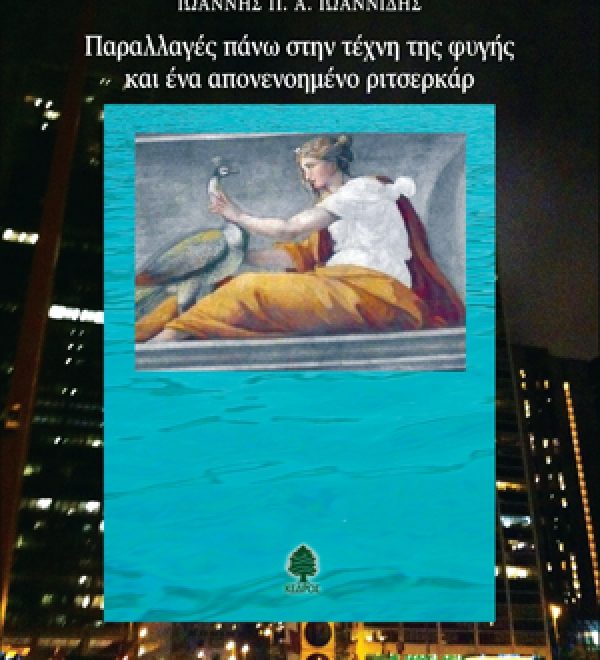
Το βιβλίο του Ιωάννη Π.Α. Ιωαννίδη, “Παραλλαγές πάνω στην τέχνη της φυγής και ένα απονενοημένο Ριτσερκάρ” (Κέδρος, 2014), δημοσιεύεται ξανά σε έκδοση e-book (https://www.kedros.gr/product/9146/variations-fugue-desperate.html?language=en), ως δυο βιβλία hyperlinked το ένα με το άλλο. Το πρώτο είναι η αγγλική εκδοχή των Παραλλαγών (Variations on the art of the fugue and a desperate ricercar) και το δεύτερο λέγεται Annotations/Επισημειώσεις, το οποίο εξηγεί, επεκτείνει, συμπληρώνει, ανασκάπτει και υποσκάπτει, ίσως, τις Παραλλαγές, όπως λέει ο ίδιος ο ποιητής.