Ο Σάμπα Γιασίμ δεν συμμετείχε στο San Francisco International Poetry Festival επειδή δεν του χορηγήθηκε βίζα από την Αμερικανική Πρεσβεία στο Λίβανο…

Al-Mutanabbi* : The prophecy is at the birds’ beaks!
* ( 915 – 965 Iraq) in full Abu at-Tayyib Ahmad ibn Husayn al-Mutanabbi poet regarded by many as the greatest of the Arabic language. He primarily wrote panegyrics in a flowery, bombastic style marked by improbable metaphors. He influenced Arabic poetry until the 19th century and has been widely quoted.
Al-Mutanabbi was the son of a water carrier who claimed noble and ancient southern Arabian descent
It was during his youth that he got his name, which means “the one who wants to become Prophet”, when he participated in revolutionary movements.
** In Acadian mythology Humbaba (Assyrian spelling) or Huwawa (Babylonian) was a giant monstrous ogre of immemorial age raised by Utu, the Sun.
Humbaba/Huwawa was also the guardian of the Cedar Forest where the gods lived.
Both Gilgamesh and Enkidu cooperated in killing evil represented in that giant monster and thus they saved not only Uruk but the whole world.
That’s what “Gilgamesh” epic says.
That was a special, big garden, a forest
where all types of trees and flowers grew;
the trees bending down gently flinging branches:
Our orchard grew like a crown on the Sunʼs eyebrow.
Where did Humbaba come from?
His mother was just a cave, his father unknown.
Who made him a friend-pretending guardian of the orchard?
Did those nice shrubs need fear to go begging for a guardian
and have Humbaba and his treacherous ilk?
Those plants and flowers were like books
everyone could read, not cut and throw away.
Their different, fantastic colors had formed our blood
so that our veins ran smoothly, our Seven Wonders showed.
Then Humbaba made a whirlwind of fire and snow.
Who crowned him king?
Who showed him our garden was but a jail?
Humbaba was great and scary but not so very strong,
though no one could ever conquer him as no one would ever try.
Time and again, when things grew old,
Humbaba alone believed himself eternal and young,
still powerful, able to defeat all.
Humbaba didnʼt want to know one fact:
That accumulation will lead to eruptive change,
but sadly when suddenly he realized it after all,
he chose to check its power on all—the hard, the tall:
The ogre cut all the willows and left them wailing behind;
he crushed all the shrubs and plants,
leaving them creeping and broken all over;
he damaged the flowers and colors,
the flowers withered, their leaves all burned,
and soon they were throwing their seeds everywhichway,
and when the whole orchard changed into a dry, grey waste,
Humbaba, his mind like stone,
shouted his horrible cry of fire
and burned all that grey and yellow.
Birds of all kinds were flying away
with ashes in their beaks,
which Humbaba couldnʼt oversee anymore
or ever set on fire.
*
Thus Grandfather ended his day and continued
closing his big, thick yellow book,
turning to his grandsons and daughters
and handing them a big red bud,
then bidding goodnight
and laying his head on his yawning book
he glances solemnly at the full moon in the core of the sky,
his eyelids blinking once, searching for that big silvery rose.
ZANNOBA not ZANNOBIA
Horribly deep down at the bottom of a well
Weʼve barely been trying to get out,
Doing our best almost always, but in vain
When Josef wretchedly stretched out in the pit
Just to make sure God sent him a passerby
More than once we could get to the edge but
With Sisyphusʼ rock soon went rolling back down.
Then, outstretching our arms to the utmost
On hearing Godʼs horrible cry in awe,
Suddenly a passerby coolly called down
And snatched us all up and saved our lives!
We couldnʼt see who he was at first. Some said God,
Others said Satan, mothers said the true Savior!
Our heads were beaten down between our thighs
So only by arm-pulls could we come to level ground:
Burnt lands, buildings and trees destroyed all around,
Hollow skeletons, crushed bones everywhere!
The Euphrates waterʼs red, fishes polluted by rotten flesh,
Some of lovers, others of sisters, oh mothers!
We found the burned land threatened and promised by him,
That macho dictator of an unelected tyranny.
Elfin Zannoba used to call, visit us her friends, in peace;
Her oil-silken half-skirt revealed glowing soft thighs;
Her prayerful victory-blinking eyes were wide and clever;
White, purple, ruddy—whatever color, her body shone!
She created her own female colors, none of them alike,
For her well-built chubby-wonderful body where sirens would hide;
Her firm, electric breasts were two angels, hurled
Pomegranates that gave life rather than grenades that made graves.
A bit of joyful jiggle in her hips when she waddled;
She was polite, shy with a never fulfilled wish,
A shyness that enticed politeness with a quiet respect.
She moaned a whispering free verse;
Such a touch of beauty she held and had,
Who could even dare molest her?
Hints of thigh, a breast-line clear as a rising sun-disc peeping,
Or those sacred luring nipples like withdrawing snails,
Showing a lovely smile upon her face!
Cheeky reddish cheeks would glow while
A harp messaged its magic music all night long.
Then all of a sudden, Zannoba disappeared.
All the violets, lilies, flowers dully faded away.
Zannoba went away all along the sunsetʼs yawn.
No more that beauty, nor music nor the vine!
Then, one day among many gloomy ones, our mobile rang:
Zannoba was on the other side of the country
Lamenting that her brother had been murdered,
A young brother had escaped, her father was slain, her mother raped.
Zannoba could beguile the sun no less than a mobile phone,
So how could one be ingrate and full of blame,
When the passerby pulled Josef from the pit alive
Or pulled us all from that deep dry-dump well?
Should we be ungrateful for that beautiful (so ugly) guy
Who saved us from the rot of our greedy neighbors,
The filthy Saudi extremists, the Islamo-fascists and the likes
Of Bin Laden, Zarqawi, Saddam and the Taliban?!
What horrors we should then have had to endure
Under those false, long-bearded, castrated so-called men!
Once such creatures would rule a while
A tragedy would then be rumbling behind?
Yes, Zannoba may weep some more, suffer in distress awhile
Never regaining her family, but sheʼll find new brothers nearby
And certainly will smile again,
Her jinni-like laughter soon triumphing.
Open Sesame! Weʼll all cry out
And thatʼll be the end of sadness.
Not to half but to all sorrows, letʼs firmly say: Goodbye.
Just then, once the drowned got back their breaths,
The Savior ordered: Go back deeper down the pit;
He was only trying to smell them
To make sure they were still rotten!
And leave them then back, deep down, stuck.
Aiii! for all that trickery, Aiii! for all that trust!
Sisyphus has to bear his rock again to his utmost!
* * *
* “Dear Sabah—- I wanted you to know that I read your Zannoba poem last night publicly to about 75 people in an event here in north beach in San Francisco and it was extremely well received. People loved it!!! and send warmest regards to you.—sempre—jack” Tue, 11 Jul 2006 11:03:37 -0700
Note: “jack” is Jack Hirschman ,75 years old , the 1st poet of San Francisco, recently published his masterpiece work of arts” The Arcanes” a 1000 page book about his poetry.

June/July, 2007
Poems by Sabah Mohsen Jasim
Translated by Kareem James Abu-Zeid
Translatorʼs note for “The Marsh Butterfly”: The Iraqi garbage trucks, which so often clean up the streets after air raids or explosions, are orange in color.
Poem # 1
The Marsh Butterfly
Certain Tibetan legends claim that vultures will not eat the bodies of those who sinned in life.
It seems to hum
As it takes flight.
It enters our neighborhood
And flies about
The winding alleyways.
It surveys the scene
And looks at us.
One after the other
The bright orange colors
Whisper in longing:
“Here!
Weʼre over here!”
***
What stupidity.
Our landfills
Are mute,
Lame,
And overflowing:
They loose their floods.
This, the strangest of transformations,
Leads only to destruction.
Its taste,
Bitter,
Is still beneath our tongues.
Our words are eloquent…
Yet full of fire.
***
The marsh butterfly
Is no longer
The one weʼd come to know;
Itʼs renounced our ramshackle houses
Where the trash, the rubble,
Is piled high.
It glides so smoothly through the air,
Graceful yet harsh,
And leaves us.
Our coffers,
Brimming,
Begin to flood the streets
While we wait for news,
For any news,
And count the moss-colored money.
We pay,
Then start counting once again.
***
Under the protection
Of the traders of death,
Our mortal selves wake up
To the sound of gunfire.
This daily terror
Has vanquished love and joy,
And our hearts become as stiff as heartwood.
We keep a teary lookout:
What shape will death take
This time around?
Frustrated, impotent, we take
To hurling insults at each other.
And we forget
The carefree days of youth,
That cotton-like candy we used to eat,
“Shaʼru banat”—thatʼs what we called it:
“Girlsʼ hair.”
***
The garbage truck makes the rounds,
And its orange-clad men
Signal to each other in surprise,
For the rest of us are busy fighting.
We utter the foulest words within us,
We unearth a history of conflict
Invented by our enemies,
And mutter angrily
That we canʼt even piss in peace.
The cats have fallen silent,
The neighborʼs voice is gone,
The lemon tree has withered,
And the roar of the planes overhead
Is incessant.
And yet, burdened as it is, the orange truck
Is still there, crossing
Through the alleys, crawling
Through our remains,
And showing us
A certain heartfelt kindness;
Our butterfly feels joy, and hope:
Something in the world is changing.
***
The men in orange wave to us
As they sport their masks and stylish clothes,
And darkness slowly yields to light,
Laying bear the hatred, the division.
In their usual humble way
They flash us a simple smile
And chase away our isolation.
Yet our faces, still wracked
With alarm, with dismay,
Betray us,
And my fear returns:
A single question mark
Writhes and groans,
Wails, slithers its way amidst our graves:
When, when will the vultures come for us?
Poem #2
Waking Up Again
February 1st, 2006
We used to love our mirror,
We used to love
The singular creature we saw in it.
Then we were killed,
And when we woke up again
The sound that we heard
Was the whetting of knives.
We argued long about what this meant,
And some of us rejoiced and made ready
To greet the arriving guests.
And others among us went back to sleep,
Back to the starry skies of dreams,
Before beginning to bicker once again.
At last, we filled the cups with milk,
We slaughtered our only lamb,
And topped this off with dates:
“Have some!” we cried. “Have some dates!”
And afterwards: coffee and tea.
We saddled our best horses, our finest camels,
And took our guests wherever they would go,
Showing them all the courtesies of custom.
Again we woke up, and suddenly
We were walking naked through the night, listening
To them drinking, to the sounds
Of their carousing.
We busied ourselves with their hoses
That were pouring forth from our great river.
We cut off other hoses
That were spewing out our blood
Across the borders.
And now the two visitors of our night
Speak in heated tones.
They give the signal
For us to rest the camels.
One of them laughs, and the other asks:
– “What is it? Will we be making camp with them?”
– “Who said that we were leaving?
Tell them to sleep outside the tents,
Then go and break their mirror,
Stir up strife among them, fuel
The flames of discontent.
For the time has come
To sweeten the pot
And roll the dice:
Itʼs time for us
To devour the desert
With their brains.”
Translatorʼs notes for “Nazik Al-Malaika”:
Nazik Al-Malaika was one of the most renowned Iraqi poets of the past century. She was born in Baghdad in1922, and spent some 40 years teaching Arabic and literature in various Iraqi universities and schools, all the while building a reputation as one of the Arab worldʼs leading poets. She left Iraq in 1970, two years after Saddam Husseinʼs Baath Party came to power, and moved to Kuwait. Following Saddamʼs invasion of Kuwait in 1990, she moved to Cairo, where she lived until her death in June, 2007. Her name “Nazik” is possibly a variation of the Arabic word nayzak, which means “comet.”
The poem also contains a reference to al-Khidr, who is considered a saint by some in the Islamic tradition, and to whom candles are often lit. Certain traditions equate him with the biblical Elias. In some versions of his story, he is said to inhabit the waters of both the Tigris and Euphrates, and it is said that his mere presence is enough to turn the desert green—the name “al-Khidr” literally means “the green one” in Arabic.
Finally, the end of this poem also makes reference to a popular Iraqi childrenʼs song in which children climb a mountain and suddenly come upon the beautiful palace of a sultan. One of the children—whose name is Umran—lazily puts his legs upon the palace, as if it were a footstool. The children then proceed to call out to their beloved uncle Hussayn, so that he can share in the joy of their discovery.
Poem # 3
Nazik Al-Malaika… The Cooing of a Ringdove
Legend has it that anyone who drinks from the water of the River Nile is put under a spell that will cause them to return to the river one day.
Princess of seagulls,
Dismay in the eyes of a ringdove,
Weeping, you think of us, and remember:
When we were young we used to play
In the winding streets,
Beneath our vine-decked trellises,
Amidst your white doves.
You weep in alarm,
And lower the curtains
With reticent hands,
Swiftly concealing
Your naked gleaming grief.
We see you in our thoughts,
Confident
And with love in your heart,
As giving as our palm trees:
The rose-colored comet.
You kindle our love
And cure the sickness within us,
Who suffer from oblivion.
Your seeds are still our store of treasure,
And the mud of the Euphrates
Plays with the dew of our love
While the ringdove sings.
Beauty, we torture you with our love,
And in return you give us grace.
Your passion blazes,
Baghdadʼs mornings begin with you,
And her nights are full of sleep.
At dawn, the gulls cry out your name;
The fish of the Tigris would bear you as their bride.
A perfume rises from the river, and is lost:
So what about you, who gathered up
The perfume of both rivers,
Then performed the ablution
With the Nileʼs affection?
Lush, your poetry
Spells out our constellations
One star at a time.
Our souls praise your name
And the gulls cry out to you.
As your ancient train passes,
Our desert turns green.
Come, come to the Tigris,
Where a single smile from you
Will be cause for celebration.
…..
The Tigris and Euphrates are your twins,
They are our prayers.
We bring our peace to you
On a tray of fronds,
Amid the candles of Al-Khidr
And the hymns of the poor.
Thereʼs wealth left yet
In our Iraq,
Despite these passing wars,
And in spite of all conspiracies.
Has exile made you forget
The stories you once heard
Of the Tigris and Euphrates?
The gulls cry out:
“Nazik… Nazik… Nazik.”
And the ringdoves coo:
“We climbed the mountain.”
Yes, your people are still singing
That old childrenʼs song:
“O uncle, o Hussein,
Weʼve found the Sultanʼs palace!”
But Umranʼs figure
Is a question mark;
His legs falter,
And he is like those birds
That sing despite their wounds:
“Ukhtah!” he cries, “O sister!”
Sister, it does not matter
Where you make your home:
For the Nile
Will not take you from us
Just because you drank from it.
Translatorʼs notes to “Lip Service for Hussein”:
The title of this poem refers to Hussein ibn Ali, the grandson of the Prophet Mohammad and the third Shiite Imam (i.e. male descendant of Mohammad). He refused to accept the appointment of Yazid to be head of the Islamic Caliphate, and led an army against him, but his host was greatly outnumbered and he was killed in the Battle of Karbala (680 AD). Hussein is considered a martyr by all Muslims, yet he is especially revered by the Shiites, who sometimes dub him “the resurrector of Islam” and view him as having boldly defied the tyranny of Yazid. His death was a defining event for the Shiites.
Yazid, on the other hand, is generally reviled by both Sunnis and Shiites, most of whom consider him to have been an illegitimate Caliph, and the one ultimately responsible for Husseinʼs death. He died suddenly in 683 AD. To this day, he remains the quintessential villain for members of the Shiite faith.
The list of names at the beginning of this poem evoke the earliest days of Islam, in particular the splitting up of Islam into the Sunni and Shiite faiths because of disputes over who would have control over the Caliphate. The irony of the situation, as this poem makes clear, is that all of those vying for power were in fact the closest of kin.
Further on in this poem, there is also a reference to Bilal, who was an Ethiopian chosen by the Prophet Mohammad to be the first muezzin—i.e. the man who calls Muslims to prayer—in all of Islam. He was famous for his resonating voice.
Poem # 4
Lip Service for Hussein
They killed you
For Abd Munaf,
For Hashim and Abd Shams.
The Umayyads, Harb,
Abu Sufyan,
Muawiyya and Yazid—
All of them were your cousins;
They made peace then broke it,
They fostered unrest
And allowed those who stopped the killings,
Those who favored peace,
To be killed themselves.
We gather up whatʼs left of us
And smell the dust of your martyrdom,
We love
Beneath the edges of the sword,
Amid the rattling of rifles;
And our mouths water
As the scent of gunpowder fills the air.
After inheriting over a thousand wretched years,
We still donʼt have the courage that wisdom wants.
Yes, we did learn of certain things:
We learned the eagerness of your killers,
We learned ruthless ambition,
The falseness of promises,
The breaking of contracts—
None of this was in you,
Yet we still paraded you in our ignorance,
We still bore the weight of our losses,
Eager for exculpation.
And now we pray,
While nothing we do
Is based on religion—
Where will all this end?
Our rulers oppress us,
They race with the asses
And we follow them, tired,
But just as brainless.
We gained nothing from the sewers of these seeds,
Nothing but promises,
And yet we praise them.
Sanctity and sacrilege—this is our way.
Hussein, weʼve paid you lip service.
What words should we now speak?
What have the Muslims done with the Muslims?
Who are we punishing by killing each other?
Who gains from our disputes?
Who do we comfort by pillaging you,
By putting you in chains?
Would it suffice for us to tell your story?—
How they called for your retreat in vain,
How they left you naked on the battlefield,
Your own close kin,
And kept all of us
From realizing the promises of our faith.
A thousand years and more have passed
And what have we accomplished?
The beating of drums lures us in
And we strike our own breasts in rage;
We light flames beneath enormous cauldrons
So we can gorge ourselves, year after year,
Until our heads throb in pain;
Yet even so, each new day
Brings hunger back upon us,
Hunger and iron chains—
We only ever dream of death.
We wake up, and listlessly
Humiliate those who till our land,
Then somehow justify importing food,
And label it halal, whether it is or no.
We take to decreeing laws again:
We begin by banning murder,
Then carry out the worst of massacres.
We incessantly swear our oaths—meaningless, all of them.
We make our mouths water by banning wine,
By imposing veils on all the women.
We lose respect for one another,
And take to swords and daggers—
Life hardens,
And the drumbeats call
For the world to right its ways.
We lament the marks upon our brows
As we pray towards a house made of money,
Whoring ourselves to it.
Our crops fall short, but we refuse
To tighten our belts—we only want
To eat our fill, whatever the price.
Even the call to prayer has changed—
Whatever happened to the Bilal we knew?
What keeps us from one another?
Why does Yazid take root in all of us?
Master of martyrs,
Donʼt let our grief darken you,
One day we weep for you
And split our heads with chains,
In agony and in grief,
Yet the next day we forget you in our judgments.
Dissension, fanaticism—
These are our trademarks.
We hurl epithets at one another
And cling to the secret of our trade,
To our daggers and our swords,
Bestowing heroic names upon them.
We cut off the heads of those we imagine
To be our enemies, and itʼs like the days before Islam,
The days of warring tribes.
We never learned the secret
That dwells within our stones—
When will we find the way
That leads to you, Hussein?
Forgive us, for weʼve lost our Islam.
And what religious men today
Live up to your example?
We used to wear robes as green as olives,
But now they are black.
What will we say on Judgment Day?
We fear our words
Will betray our ignorance.
Symbol of martyrdom—how weʼve wronged you.
Give us the knowledge, the wisdom
To foster our faith; help us
Secure your redemption.
Translatorʼs notes for “Solace for the Bomber Tree”:
This poem obliquely makes reference to the infamous “Nigret Al-Salman” desert prison that was used by various Iraqi regimes of the past century to keep their dissenters in check, and it was written for the well-known Iraqi poet Saadi Yousef, who was himself a political prisoner. He was born in Basra in 1934 and has lived in exile for much of his life. More specifically, the poem at hand was written in response to one by Saadi Yousef entitled “Basra, Lost to its People”, and in particular to the end of that poem, which I here translate:
This slaughter, people of Basra, this history, these streets, this culture—
They are all entrenched occupations,
A slow asphyxiation.
And the question arises: “Is anything left of Sumer?”
The wrecking of a civilization
Is the inborn act of the barbarian,
The devastation that now rules over Basra.
And Basra
Has not come back to its people.
With regards to the title of the poem at hand—“Solace for the Bomber Tree”—, the author gives the following description: The so-called “bomber tree” (shajarat al-bambar in Arabic) is a tall tree native to Basra. Its fruits—which contain a single pit—have medicinal properties and provide a sweet and viscous juice. When its fruits ripen, they fall to the ground with a noise that resembles the falling of bombs—hence the treeʼs name. The poem traces the treeʼs movement from the southern city of Basra northwards to the province of Babil and finally to Baghdad.
This poem also makes reference to swallows, and it should be noted that these birds generally migrate to Iraq in the summer, and that their eggs are not entirely dissimilar from the oval fruit of the bomber tree.
Finally, this poem mentions Umm Al-Buroom—this is a large square in the center of Basra where Iraqi workers often gather to be hired by those who need their services.
Poem # 5
Solace for the Bomber Tree
For Saadi Yousef
You are still here, and rest assured
That you will not be leaving us—
For Iraq is hard to digest,
And theyʼll vomit it up like poison,
These extremists,
As they suffer through their torture.
They slice through bricks and marble,
They speak frankly, but only in secret,
Hypocrites weaving laws and interdictions
With your poems, with your murmurs and volcanic soul,
That soul that still
Shines on Basra, that yet sheds light
Upon its people, upon Umm al-Buroom.
Yes, you are remembered
Like the alleyways of fleeing protestors,
Like their desert prisons,
Like their words of defiance.
***
This tree that the old woman brought from Basra,
Giving it its dreadful name, “the bomber”—
Its fruits are gleaming now as it advances
On Babil and Baghdad,
It nurtures its virtues in spite of the heat
Plunging its roots into the depths of sadness,
It surrounds us, terrifies us with leafy branches,
Roaring from all sides, advancing in step,
Announcing its arrival—as green as gunfire.
And as the July heat grows
In this land between two rivers
The fruits, red-hot, come crashing down…
They cure our hearts of their disease,
Of this torturous waiting for a newborn day,
They cast out the corroding smoke within us,
The pus and the many-colored lies.
The black and wrinkled veil
That once covered the old womanʼs head
Is like a nest for the swallows,
The swallows that have not left us
Despite this autumn of our land;
And now the children gather up their fruit in it,
But the youngest among them cries out
In protest and perplexity:
“How can so small a thing
Hold so much fruit?”
Poem # 6
Musician, Show Some Mercy
The stormy wind
Plays stubbornly
With my bitter orange trees,
Ripping out
Pearly white beads—
Have you ever felt the fury of the wind?
My trees are dancing, and so I rush
To shore up their trunks
With my arms,
With my body.
Their ardent fragrance fills the air
Amidst the pounding of our hearts;
A sigh escapes from them, from me—
It rises
And it falls.
The beads, quicksilver,
Quickly slip away.
These thick branches anger me,
These hanging crowns;
For joy, they cry out to the wind:
La illaha illa allah—
“There is no god but God.”
They find a harmony,
A music for their words,
And flock together, ever nearer,
While I—bewildered, alone with the wind—
Howl like a wolf.
Suddenly, the moon unsheathes its fullness,
The strangest of talismans,
And I embrace my dancing trees,
Perplexed, as if this were a labyrinth;
Perplexed, my eyes renounce their sockets,
While the musician
Keeps on playing,
And the stormy wind
Hurls young lotus fruit every which way,
And the trees cast off their pearly blooms.
My golden fish set off—no,
Not golden.
………
They forsake the Euphrates, swimming
In swarms like angels, leaping
High above the water, as silver
As moonglow.
They advance in fragrant waves,
Racing with the wind, and pass
Through our lemon trees
In successive shoals.
They are here now, swimming
Amidst the wind, kissing
My breast as they pass me by,
Indifferent
To the dying of the wind.
The unseen fragrance
Spreads above our garden streams;
My uncertain tears
Consider the dust
Of so many slain stars
In horror, while the rest keep their calm:
Are such victims truly necessary?
…….
My pearls grow weary;
I weep in consternation,
While all else is full of joy,
And I realize…
The full moon is whispering,
My trees are panting,
And the fish still swimming in their shoals:
They flit around me, around the trees,
And press onward,
While the musician, alone,
Engrossed in his song,
Keeps on playing—
So unconcerned
And undisturbed.
Translatorʼs Note: Kamal Sabti was a well-known Iraqi poet. He was born in Nasiriya in southern Iraq in 1958, and died in exile in Holland in 2006.
Poem # 7
Kamal Sabti: My Lark, and the Voice of Our Plight
My lark bows its head.
I set aside
The rest of my glass
Among the branches of the desert cloves
And sip some juice from their buds.
I look at my lark in alarm:
Itʼs strangely still today,
As still as I am.
Its eyes let slip a tear—
As do my own.
Today my lark is silent,
It doesnʼt rave as I do,
And when I ask it why
I donʼt receive an answer.
Its eye is on my glass—
Perhaps I should give it
Whatʼs left of my drink;
Perhaps itʼs thirsty.
………..
The wind smells sweet as ambergris,
The grain is ripe to thresh;
Yet my bereaved lark sighs
Amidst the scent of cloves
And ambergris;
“What is it?” I ask.
It only answers with more tears.
“What is it? Whatʼs the matter?”
I wipe my lips, perplexed, and wonder why
Itʼs so weary, so
Worn down today.
I beg for an explanation,
But to no avail.
“Whatʼs wrong?” I ask.
It holds its tongue.
So I gather up the wine, the scattered glasses,
And say a few words in parting:
“This is the glass of Kamal Sabti,
A friend, a brother,
And these are his leek leaves;
If he returns in sorrow
Tell him Iʼll be right back,
But do not disturb him,
Remember
Not to shed any aimless tears—
Henceforth we will not howl at the silence,
Nor did we ever do so
Before this day.”
Translatorʼs note: Atwar Bahjat was an Iraqi journalist, poet, feminist and fervent supporter of a united Iraq. She was kidnapped and assassinated in Samarra in February 2006 while reporting on the bombing of the Al-Askari mosque for the Al-Arabiyya news network. She was 30 years old.
Poem # 8
Atwar… Still Laughing
Poised in a rose, a yellow spider
Watches me in wonder; her gaze
Is unsettling, and I make my excuses, thinking
That Iʼd go find another flower.
Yet I was so enthralled by her—
This little yellow spider still
Staring at me, warily examining
My every move—
That I smiled, trying to reassure her
That weʼre on each otherʼs side;
I devote my prayers
To such yellow purity.
I picked up my buckets,
Made my way towards a well,
And saw the small palm trees of my grandmother
Luring me in with their amorous eyes,
Whispering in the softest of tones:
“Give us water—give us all you have.”
The rustling of a lotus tree
Charmed my ears,
The rustling
Of a mulberry tree,
Of grapevines,
Of a fig
Or an olive tree;
I count them all in turn—
No… Thatʼs not an olive tree.
My shovel carried me up
To where the sun was pouring forth its rays
Into my eyes—
“How vast this desert is!” I thought.
I saw the sun weeping,
It told me that these were its tears,
And so I asked it,
“Is this the way you water things?”
And it replied,
“Itʼs how I give them life”;
And I marveled at such benevolence.
My shovel and my buckets lifted me
Towards the darkness,
And as I proceeded, I heard
The sounds of whispering scarabs on the sand;
My feet faltered, and my buckets
Were cast into confusion
When a sweet scent
And a fair breeze
Filled the air.
I groped about in the darkness, found
A patch of wild flowers—
“Here!” I cried, while my shovel
Carried on with its lamentations;
It was a womanʼs scent I smelled,
Yet I was too late…
I…
…
I started to weep, to weep because
Nothing is more giving than a woman;
And I laid blame about me,
For how could I accept
A world where women are killed like this?
I kept at it until the break of day,
By then the grave was wide and deep;
Her coffin approached, decked in blue flowers;
I kept on quietly chanting, and a solemn old man
Joined in with me;
He planted some seeds, and it almost seemed
That Atwar was waving from the deck of her boat,
Her shawl billowing in the wind
As she clutched those flowers, those lilies,
While I stood there in my robe,
My buckets filled to the brim.
She forgot her inhibitions, and asked:
“Where are those seeds that…
…
Really, where did you put them?
Or rather, where did you lose them?
They were with me just a moment ago.”
Hoping to please her, I said:
“Here, take these buckets of water.”
“Whatʼs this?” she replied consolingly;
“Who said I wanted tears?”
“I thought it was water from the Euphrates,” I explained.
To set my thinking straight, she said:
“What if the Tigris were to leave?
What would the Euphrates be without it?
Who could ever love
Only one of them?
Who could ever embrace
One of them by itself?”
I heard the echo of my voice grow fainter:
“This is the Tigris,” it said. “This is the Tigris.”
Then, suddenly, everyoneʼs ears perked up:
“Did you hear that?” the old man asked me.
I followed his gaze and touched
The dew, the damp soil with my hands.
My tongue began writhing
Between my two convulsing jaws,
Imploring God with that Coptic funeral chant:
“Kiriyalison… Kiriyalison”—“Lord have mercy upon us.”
And then the sound
Of laughter rising from the grave.

Biographical Information
Name: SABAH MOHSEN JASIM
Surname: AL-DULAIMI
Date of birth: 01-07-1950
Passport # G 1308273
Issuing Authority: Baghdad
Date of Issue: 01-07-2007
Place of birth: AL-QADISIYAH , IRAQ
Nationality: Iraq
Education : BA degree English Language & Literature
College of Arts , Baghdad, 1974 / 75
Status : married, 4 sons & 1 daughter
Position: Ex. Teacher , older manager in Research & Development in a state chemical plant .
Character: Writer & Journalist
Member in THE UNION OF IRAQI WRITERS card # 1167
Member in IRAQI JOURNALISTS UNION card # 8255
Activities:
– Participant in the San Francisco International Poetry Festival held in July 27-29, 2007.
“Obsessions Of No Memory” , a collection of Arabic poems.
“That Wild Flower” , a collection of 20 short stories. (under publication)
Translation of some English poems into Arabic.
Defining of literature of neighboring countries; Turkey & Iran . Translating poems of some famous Persian revolutionist poetesses & poets. Same with articles about the famous Turkish novelist Orhan Pamuk.
A participant in AL-MARBID poetry festival 3rd & 4th sessions held in Basra in 2006 & 2007 successively.
Permanent participant in IRAQI WRITERS UNION website
www.iraqiwritersunion.com , Arabic poems & Arabic short stories together with different literary articles.
– WPS (World Poets Society) member
– Reading poetry in AL-MUSSAYEB WRITERS FORUM evenings.
After the regime topple , started joining in those liberal websites to issue different writings ( short stories , poems and other political assays) in :
Modern Discussion , Iraqstory.com, Iraqihome.com, www.iraqiculture.net, sootaliraq.com, Kika.com, Iraqiwriters.com, Iraqiwritersunion.com.
Further , a private website www.sabah.friendsofdemocracy.net ( more than 100 literary articles)
A quick survey :
1973 : literary criticism issues in some liberal local newspapers.
1974: Joining in Afro-Asian Peace Conference held in Baghdad ( 67 participating countries )
1976: Participating in a journalist training session held in Baghdad under the supervision of Tareek Al-Shaab , the main newspaper issued by Iraqi Communist Party.
1978: soon after the failure of the Front ( political agreement realized among 3 Iraqi main parties in 1973). A bitter attack occurred against all communist people together with their friends and followers. Being chased and forced to leave work as a teacher in a secondary school.
Being kidnapped, then escaped to spend life as a fugitive !
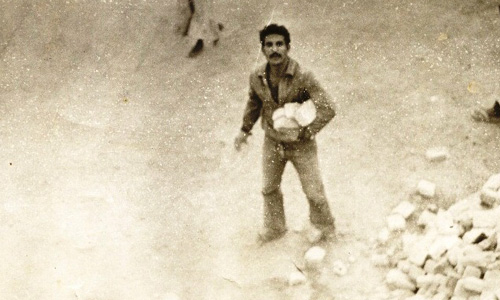
Doing hard jobs to survive wife and child in southern part of Iraq , worked as a coli carrying heavy sacks of iron soil from ports in Basra , the safest way to be away of the state detectives’ eyes.
– End of 1978 , an amnesty announcement for those runaway politicians , to come back home.
-Being refused as a teacher unless joining the main ruling party , accepted to work in a state cement plant . Same with wife who was a teacher for girls in secondary school.
Practically , ex- communist members were under watch, especially those who insisted not to join state main party and could not help running away far away of Iraq.
Consequently, since 1978 up to the regime topple in 2003, no liberal or communist writer could have published any of his own works inside Iraq. If any could do that then it would be suspected for a behind purpose.
Only those who could escape across Iraqi borders have in a way or another the chance to publish their books upon their account .
1996: Retired
1997: imprisoned in Juwaida prison , Jordan by a demand from Iraqi government Interpol.
1998: set free under a plea that found not guilty of an accusation – mainly arranged by those aggressive political forces in the Iraqi state at the time of dictatorship.
1999-2002 : a commercial manager in a Jordanian-Iraqi trading company.
Traveled to Romania , Lebanon, Egypt & UAE.
2003: Back to Iraq establishing with other 3 partners AL-DAYSAM Trading Co. office in Baghdad.
2004: Closing our company office after one of our partner’s being kidnapped by some insurgents and never returned.
2005: Back to work in old plant of Iraqi state companies.
– For the time being, literary articles be noticed in some distinctive Iraqi magazines – like AL-SHARARA and TAWASUL and newspapers like TAREEK AL-SHAAB, ALTAAKHI & AL-MANARAH newspapers.
Note: real work of art that has been well performed is caring for wife Selma who has been suffering ‘ black curse’ coma state of mind since 2002! – Surely there was a certain conspiracy made by the old regime to interfere in her surgical operation to remove a gall bladder -. That is the sole work to feel very proud of – in such very bitter circumstances of political conflicts- under an unfair occupation to Iraq that has been enduring ever since 2003.